



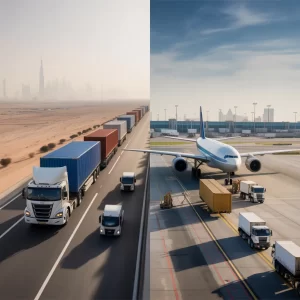


In recent years, trade and economic cooperation between the United Arab Emirates and the Kingdom of Saudi Arabia has grown rapidly. As of 2023, Saudi Arabia ranked as the UAE’s second-largest trading partner globally, with a significantly higher non-oil trade volume between the two nations.
As businesses expand their operations across borders, reliable and efficient cargo services become critical. This also increases the need for logistic options for successful operations.
Saudi Arabia is not alone in this progress. GCC has shown immense economic success, and data have shown that GCC economy and road freight are linked tightly together in this rise.
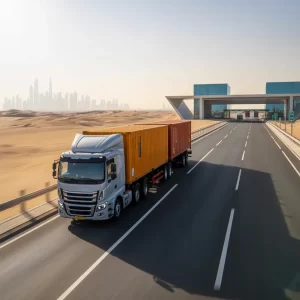
Among the many logistics options available, Full Truckload (FTL) shipping has emerged as a preferred method for companies transporting goods from Dubai to Saudi Arabia. It’s also a key method used in routes like Dubai to Bahrain cargo and Dubai to Oman cargo, supporting broader regional supply chains.
What Is FTL Shipping and When Should You Use It?
FTL, or Full Truckload shipping, refers to transporting goods that occupy an entire truck’s capacity. In contrast to Less-than-Truckload (LTL) shipping, where multiple consignments share space, FTL is a dedicated transport solution for large or high-priority shipments.
It offers advantages such as faster transit times, lower risk of damage, and better security, as the truck only stops for customs and fuel.
Businesses should consider FTL shipping when their cargo volume exceeds 5,000 to 10,000 kilograms or if they need to fill up a trailer of about 24 to 33 pallet spaces.
This method is ideal for manufacturers, wholesalers, or retailers with significant order sizes, especially those who operate across borders. In the Dubai to Saudi Arabia route, FTL is often used for bulk electronics, automotive parts, construction materials, and FMCG goods.
Within the FTL shipping model, there are different vehicle options, such as:
- Standard trailers (ideal for dry goods)
- Reefer trucks (for temperature-controlled items)
- Flatbed trucks (for heavy machinery or oversized loads)
FTL shipping is particularly suitable for shipping from Dubai to Saudi Arabia because it provides predictable delivery timelines, minimizes handling, and reduces regulatory complications from cargo mixing. For businesses aiming for consistent service, especially those expanding into KSA’s growing markets, FTL ensures reliability and efficiency.
Documentation Required for FTL Shipping from Dubai to Saudi Arabia
Efficient FTL cargo movement from Dubai to Saudi Arabia hinges on having the right paperwork. These documents validate ownership, ensure regulatory compliance, calculate duties, and protect both the sender and receiver. Here’s what you need:
1. Commercial Invoice
This core document outlines the transaction details between buyer and seller. It must include the item description, HS codes, quantity, unit price, and total value in SAR (Saudi Riyals).
To make it acceptable for Saudi customs, the invoice must be printed on the exporter’s letterhead, signed, and preferably stamped. You can obtain it from your accounting or sales department, and it should align with the terms mentioned in other documents, like the Certificate of Origin.
2. Packing List
This list details the shipment’s contents, including dimensions, weights, and the type of packaging used (boxes, pallets, drums, etc.). It helps customs authorities inspect and match the physical cargo with what’s declared.
The packing list must be consistent with the invoice and should be prepared by your logistics or warehouse department. Some freight forwarders may also assist in generating this document.
3. Certificate of Origin (COO)
This certificate verifies the goods’ manufacturing origin and is often required for customs duty exemptions under GCC agreements.
In Dubai, the COO must be attested by the Dubai Chamber of Commerce and legalized if requested by Saudi authorities. This document ensures the cargo qualifies for trade facilitation policies between the two nations.
4. Bill of Lading (or CMR Document)
The Bill of Lading is a receipt and contract between the shipper and the carrier. For road transport, the CMR document is commonly used. It contains details like consignee name, vehicle number, and cargo description. The transporter typically issues it and should accompany the driver during the journey.
5. Saber Certificate / SASO Conformity Certificate
Many goods require proof of compliance with Saudi technical regulations. This is issued through the Saudi Saber platform under the SASO (Saudi Standards, Metrology and Quality Organization) framework.
Exporters must apply through a notified body and provide testing reports. Items like electronics, toys, and household appliances especially require this documentation. Applying in advance is crucial to avoid clearance delays.
6. Export Declaration (UAE)
This electronic declaration is submitted through the UAE’s customs portal, such as Dubai Trade. It includes details about the shipper, cargo value, and destination. The UAE customs authority must approve this before the goods exit the country. Typically, freight forwarders or customs brokers help prepare this form.
7. Importer Registration and E-Declaration (Saudi Arabia)
The Saudi-based importer must be registered with Saudi Customs and should generate an electronic import declaration, known as the Bayan or EAL form. This step is crucial for customs clearance on the Saudi side. The importer or their clearing agent usually handles this.
8. Power of Attorney / Authorization Letter
If a customs broker is involved, a signed authorization letter is necessary to permit them to act on the exporter’s or importer’s behalf. This letter should be notarized and ideally in Arabic. It prevents legal issues during cargo inspection or customs queries.
9. Insurance Certificate
While not always mandatory, carrying an insurance certificate that outlines coverage in case of damage, loss, or delays is highly recommended. This can be arranged via a third-party insurer or bundled into your freight agreement with the logistics company.
10. Truck Permits and Driver Documents
Trucks crossing into Saudi Arabia require valid cross-border permits. The driver must also carry a valid ID, a driving license recognized in both countries, and vehicle registration documents. The transport company issues these and must be checked before departure.
Common Documentation Challenges and Mistakes
As you can see, many documents can be involved in getting your product across the border. And it is common for people to make mistakes or miss documents, causing delays. Here are some of the most common mistakes that people often make:
- Missing or Incomplete Commercial Invoices: Often, exporters leave out HS codes or undervalue items, leading to delays at Saudi customs.
- Incorrect Saber Certification: Applying under the wrong product category or using outdated conformity reports can result in immediate cargo rejection.
- Unsigned or Unattested Certificate of Origin: Skipping chamber attestation can render the COO invalid in Saudi Arabia, leading to unnecessary duty charges.
- Mismatch Between Documents: Discrepancies in weight, quantity, or product descriptions across documents often trigger customs inspections.
- Last-Minute Document Preparation: Waiting until the cargo is ready to prepare paperwork can cause delays, especially with government approvals or attestation.
How to Avoid Delays and Prepare Documents Efficiently
But do not worry. These problems can be avoided easily. All you have to do is start early and follow these tips:
- Hire a Reputable Cargo Company: A professional freight forwarding company in Dubai specializing in Dubai to Saudi cargo can streamline the process and handle documentation end-to-end.
- Start Document Preparation Early: Gather invoices, packing lists, and certifications a few days before shipment. Some documents, like Saber, may take several days to approve.
- Use Digital Portals: Leverage platforms like Dubai Trade and Saber to avoid physical paperwork and reduce errors through automation.
- Work closely with the Importer: Ensure that your Saudi partner is registered and ready with EAL/Bayan and has assigned a customs agent.
- Double Check All Data Entries: Avoid typos or mismatched product descriptions, which can trigger costly inspections.
- Insure Your Shipment: Accidents and border delays can happen. Insurance protects your cargo investment.
Conclusion
FTL shipping between Dubai and Saudi Arabia is a vital logistics solution for businesses looking to expand their reach and deliver large-volume cargo efficiently. However, smooth operations depend heavily on getting the documentation right.
Every form plays a critical role in ensuring customs compliance and timely delivery, from commercial invoices to cross-border permits.
Businesses that take the time to understand and prepare these documents, or outsource to a trusted logistics partner, can avoid costly setbacks and unlock seamless access to the Saudi market.
Need Reliable Cargo Services from Dubai to Saudi Arabia?
At Alweam Cargo, we specialize in cargo from Dubai to Saudi Arabia, with tailored FTL solutions that meet your speed, volume, and compliance needs. We also offer services for Dubai to Bahrain cargo and Dubai to Oman cargo, making us your go-to partner in regional freight.
Contact Alweam Cargo today and let the experts at the best freight forwarding company in Dubai handle your documentation and delivery logistics, so you can focus on growing your business!