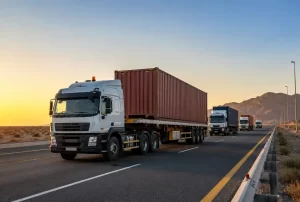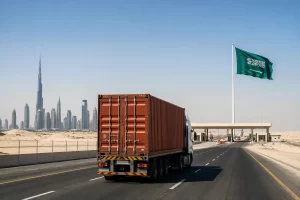
A furniture supplier in Al Quoz once told me his worst week in business started with a two-word WhatsApp message from his driver: “Still queuing.” The truck had left Dubai on a Sunday evening, cleared Al Ghuwaifat by midnight, and then sat on the Saudi side for four days while a single mismatched product code was sorted out. The cargo was fine. The truck was fine. The paperwork was not.
That story is unremarkable to anyone who runs this corridor regularly, which is precisely the problem. Border delays on this route are rarely dramatic. They’re usually a small inconsistency between what a document says and what a system expects — caught at the one place where there’s no room to fix it quietly. It’s also why so many businesses stop comparing rates on a spreadsheet and start looking for the best freight forwarding company in Dubai they can find, because on this lane the difference between a good forwarder and a cheap one shows up as days, not dirhams.
Here’s what actually causes trucks to stop at the border in 2026, and what experienced operators do differently.
One Crossing, Two Economies
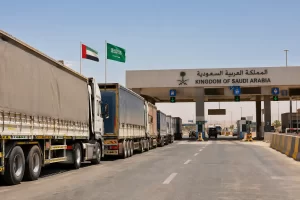
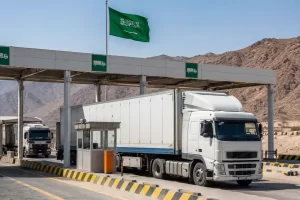
Everything on this route funnels through a single point. Al Ghuwaifat on the UAE side and Al Batha on the Saudi side form the only commercial land crossing between the two countries. There is no alternative land route. If you’re moving goods overland from the Emirates into the Kingdom, your truck goes through that gate — along with a large share of all Gulf road freight.
The crossing runs 24 hours a day and is well built for the job. It is also structurally exposed: when volumes rise, there is nowhere for the pressure to go. Through mid-2026, regional trade press reported UAE-to-Saudi trucks waiting anywhere from a few hours to several days at the crossing, with cargo ranging from building materials and spare parts to furniture and perishables caught in the slowdown. Saudi customs authorities publicly stated that operations were running normally and no disruption had been recorded.
Both can be true at the same time. The border processes cargo around the clock, and individual trucks still spend longer in the queue than they did a year ago. The crossing has a documented history of congestion episodes and, in earlier years, customs system outages that stranded drivers for several days at a stretch.
The practical takeaway: treat border time as a variable, not a constant. Any transit estimate that quotes a fixed number of days without asking what you’re carrying is a sales figure, not a plan.
The Paperwork Problem: When the File Doesn’t Match the Truck
Most delays on this corridor aren’t caused by traffic. They’re caused by inconsistency.
When shipping from Dubai to Saudi Arabia by road, your consignment is represented in several places at once — the commercial invoice, the packing list, the certificate of origin, the UAE export declaration, the Saudi import declaration filed through FASAH, and the conformity certificates registered on SABER. Every one of those records describes the same goods. Saudi customs systems check whether they agree. If the HS code on the invoice differs from the code on the certificate, or the carton count on the packing list doesn’t match what’s physically on the trailer, the shipment can’t be verified electronically. At a seaport, an agent has hours to correct that. At a land border, the truck is already in the lane.
The most common mismatches we see quoted by clearance agents across the Gulf are mundane:
- Description drift — the invoice says “machine parts,” the certificate says something more specific, and the inspector has to decide which is right.
- Quantity and weight variance — cargo repacked or topped up after the paperwork was issued.
- Consignee name inconsistency — the SABER account name doesn’t exactly match the consignee on the transport documents.
- Missing attestations — an unattested certificate of origin, or one issued after the goods departed.
- An expired PCoC — the product certificate lapsed, so the shipment certificate can’t be issued.
None of these are exotic. All of them stop a truck.
SABER, HS Codes, and the 2026 Compliance Shift
If your shipment feels harder to clear than it did two years ago, that’s not imagination. The Saudi compliance framework tightened noticeably going into 2026.
Regulated products entering the Kingdom need two things on the SABER platform: a Product Certificate of Conformity (PCoC), which confirms the product model meets Saudi standards and is typically valid for a year, and a Shipment Certificate of Conformity (SCoC), issued per consignment to confirm the physical shipment matches the certified product. The SCoC is what customs looks for at clearance.
Three changes matter for anyone loading a truck this year:
| Change | Effective | What it means at the border |
|---|---|---|
| SABER tariff codes realigned with ZATCA’s classification system | 1 January 2026 | Certificates issued under legacy codes can’t be matched to the customs declaration, which blocks electronic verification |
| Product Declaration requirement expanded for SASO Appendix 1 goods | From mid-2026 | An approved declaration from the relevant ministry must exist before an SCoC will issue |
| Additional HS codes brought under Saudi technical regulations | ~19 August 2026 | Steel, pipes, cement and concrete products, paints, abrasives and building materials that previously moved freely may now need conformity assessment |
That third one has caught a lot of construction-sector shippers off guard. A product line that cleared without incident in June may need certification in September. The lesson isn’t “check once” — it’s “check per shipment, especially if you deal in building materials or industrial inputs.”
What Customs Clearance in Dubai Actually Prevents
There’s a common assumption that border problems are Saudi problems, and therefore something to worry about once the truck is on the road. That gets the sequencing backwards.
Almost every delay described above is decided before the truck reaches Al Ghuwaifat. Proper customs clearance in Dubai means the export declaration is filed correctly on the UAE side, the invoice and packing list are reconciled against the physical load, HS codes are verified against the current tariff schedule rather than last year’s, permits and attestations are secured for restricted categories, and the import filing is lodged in advance instead of being started when the driver is already queuing. A clearance agent who does this work properly isn’t producing paperwork — they’re removing the reasons a Saudi officer would have to pull the truck aside.
Pre-filing is the single largest lever available. A shipment that arrives at the border with its declaration already lodged and verified is in a fundamentally different position from one that arrives with a folder of documents to be reviewed on the spot. The first is waiting in a queue. The second is starting a process.
Worth knowing: UAE-side and Saudi-side clearance are separate processes with separate requirements. Confirming who is responsible for each — your forwarder, your Saudi consignee, or an appointed agent — is one of the most useful five-minute conversations you can have before booking.
The Rules-of-Origin Trap
This one costs money rather than time, and it surprises exporters constantly.
Goods that qualify as GCC-origin move duty-free within the bloc. Qualifying is harder than it sounds. Saudi ministerial rules introduced in 2021 require a valid certificate of origin, direct shipment into the Kingdom, a minimum threshold of local value added at the manufacturing stage, and a minimum level of workforce localisation at the producing facility. Goods manufactured in — or routed through — a GCC free zone are treated as foreign for these purposes, which includes well-known UAE free zones.
The practical effect: a shipment the exporter assumed was duty-free arrives, the origin claim is rejected, and duty becomes payable while the cargo waits. If your goods are produced in or transit through a free zone, verify the origin position before you quote a landed cost to your customer, not after.
The Delays Nobody Budgets For
Beyond documents and compliance, a set of operational realities shapes how long a truck sits:
- Timing. Weekends, public holidays on either side, and the run-up to major seasonal demand all produce visible spikes in queue length.
- Inspection selection. Physical inspection isn’t punishment; it’s sampling. A truck can be selected with perfect paperwork. Well-organised, clearly labelled loads that match the packing list get inspected faster.
- Driver documentation. Visas, permits, and vehicle papers stop trucks as reliably as cargo documents do.
- Temperature-controlled cargo. Reefers burn fuel while waiting, and a multi-day hold turns a delay into a loss. Perishables need a different risk plan than general cargo.
- Insurance gaps. Cover that lapses at the border, or excludes delay-related spoilage, is a discovery best made in advance.
How Experienced Operators Keep Trucks Moving
There’s no trick to this. The forwarders who post consistent transit times on this route do a handful of unglamorous things well:
- Classify before booking. Confirm the 12-digit HS code against the current schedule, and confirm it’s the same code used on the SABER registration and every commercial document.
- Sequence SABER properly. Confirm the PCoC is live, then apply for the SCoC for that specific consignment — before the truck loads, not while it’s moving.
- Reconcile documents against the physical load. Weigh and count after packing, then issue the invoice and packing list. Not the other way around.
- Pre-file both sides. Export declaration in the UAE, import declaration lodged in advance for the Saudi side.
- Verify the origin position. Especially for free-zone-linked goods.
- Build a buffer into customer commitments. Quote a range, not a promise, and communicate the range honestly.
- Keep one person accountable end to end. Most delays happen in the handoffs between pickup, clearance, and delivery — not inside them.
FAQs
Why does my truck get held?
Usually due to mismatched HS codes, quantities, descriptions, or consignee details.
Are delays worse in 2026?
Mid-2026 saw longer waits due to higher volumes and tighter compliance checks.
Do all goods need SABER certification?
No. SABER applies only to products covered by Saudi technical regulations.
Can I avoid congestion by sea or air?
Yes, but proper classification and required documentation are still necessary.
Who handles customs clearance?
It depends on your agreement and Incoterms. Confirm responsibilities before booking.
When should documents be ready?
Get conformity certificates before loading and finalise commercial documents after packing and weighing.